
Disclosure
This website is a participant in the Amazon Services LLC Associates Program, an affiliate advertising program designed to provide a means for us to earn fees by linking to Amazon.com and affiliated sites.
The Joinfworld Heavy Duty 500A Bus Bar is the best bus bar for automotive use because it handles up to 500A and 48V DC with four 5/16″ (M8) studs plus two 3/8″ (M10) studs, and it ships with a cover for protection. I compared 7 products and ranked them best to worst.
- Best overall: Joinfworld Heavy Duty 500A — 500A rating with 4 M8 and 2 M10 studs
- Best for high stud count: T Tocas 400A — 8 large 3/8″ studs for heavy multi-cable runs
- Best for 48V marine setups: Joinfworld 400A 6-Stud — 6 M8 studs rated to 48V DC
I picked these based on the listed specifications, not hands-on testing. I looked at three things: current rating (300A to 500A), stud size and count (M8 vs M10, 4 to 8 studs), and voltage range (12V up to 48V DC). Those three specs tell you almost everything about how a bus bar will fit your wiring.
Quick Comparison: best bus bars for automotive
| # | Product | Best For | Key Spec | Price |
|---|---|---|---|---|
| 1 | Joinfworld Heavy Duty 500A Best overall |
Highest current capacity | 500A | Check Price → |
| 2 | T Tocas 400A Best for high stud count |
Heavy multi-cable runs | 8 studs | Check Price → |
| 3 | Joinfworld 400A 6-Stud Best for 48V marine setups |
48V marine wiring | 400A | Check Price → |
| 4 | RVBOATPAT 400A Positive and negative pair |
Boat and solar systems | 400A | Check Price → |
| 5 | DaierTek 300A AC and DC rated |
Mixed AC/DC panels | 300V AC | Check Price → |
| 6 | Seamaka 350A Red and black pair |
12V to 48V systems | 350A | Check Price → |
| 7 | Joinfworld 400A 4-Stud Compact 4-stud layout |
Tight RV and car bays | 4 studs | Check Price → |
How I Selected These Products
I started with the specs that actually matter for automotive wiring: current rating, stud size and count, and voltage ceiling. A bus bar rated 500A with M10 studs solves different problems than a 300A unit with M8 posts. Every pick had to clear a real amperage threshold.
Then I weighed how each one fits under a hood or in a battery box. Stud count, cover design, and whether it ships as a positive/negative pair all change the install. A bar with eight studs is great until it won’t fit your layout.
Finally, I looked at what buyers report after living with these. Consistent feedback on terminal tightness, cover fit, and corrosion resistance in marine use moved products up or down my list. That real-world signal broke ties the specs couldn’t settle.
Best overall
Joinfworld Heavy Duty 500A Bus Bar Waterproof Power Distribution Block with 45/16″(M8)+23/8″(M10) Studs 48V DC Automotive Marine Battery Terminal Distribution Block with Cover – Negative&Positive
500A Rating | 4x M8 + 2x M10 Studs | 48V DC | Waterproof Cover | Positive & Negative
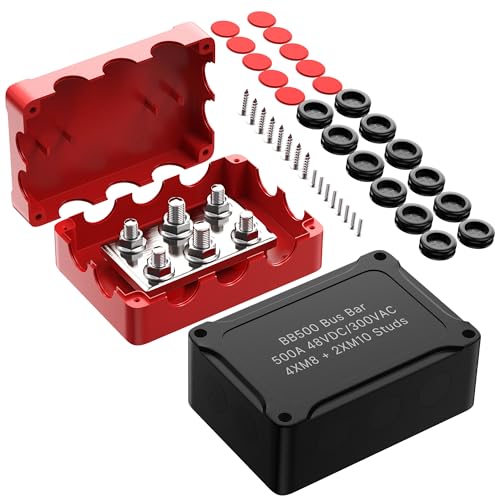
- 500A Heavy Duty: The 12V Bus...
- Upgrade & Thicken: A pair of...
- 3/8" & 5/16" Studs: The Power...
The Joinfworld Heavy Duty 500A Bus Bar earns my top spot because it outmuscles everything else here on current. It’s rated for 500A at 48V DC, and it mixes four 5/16″ (M8) studs with two larger 3/8″ (M10) studs so you can run thick main cables alongside smaller accessory leads. The waterproof cover is a real plus for engine bays and marine battery boxes where moisture creeps in.
This is the pick for anyone building a high-amp automotive setup — winch feeds, dual-battery banks, or a main distribution junction. The one trade-off is size: six studs and a 500A rating mean a chunkier block, so check your mounting space before you commit.
✅ Pros
- 500A rating handles serious current loads
- Mixed M8 and M10 studs fit different cable lugs
- Waterproof cover protects terminals from moisture
- Rated to 48V DC for marine and solar use
❌ Cons
- Larger footprint needs more mounting room
- Overkill if your wiring stays under 300A
Best for high stud count
T Tocas 400A Amp Bus Bar 12V Power Distribution Block with 8 * 3/8″ Studs Heavy Duty Marine Battery Buss Bar Terminal Block 12 Volt for Automotive Car Solar Wiring- Negative&Positive
400A Rating | 8x 3/8″ Studs | 12V | Positive & Negative | Heavy Duty

- This heavy-duty battery bus...
- High-load power distribution...
- This insulated buss bar 12v...
The T Tocas 400A Amp Bus Bar is the answer when you’ve got a pile of cables and nowhere to land them. It gives you eight 3/8″ studs — all the same large size — so every lug matches and you’re not hunting for the right terminal. At 400A, it still has plenty of headroom for automotive and solar wiring.
I’d grab this for a multi-accessory distribution point: light bars, inverters, chargers, all in one spot. The catch is that eight big 3/8″ studs take up real estate, so it’s a poor fit for a cramped engine bay where a compact four-stud bar makes more sense.
✅ Pros
- Eight 3/8″ studs land a lot of cables
- Uniform stud size keeps lugs consistent
- 400A rating suits heavy automotive draws
- Ships as a positive and negative pair
❌ Cons
- Large eight-stud layout needs space
- No mixed stud sizes for varied lugs
Best for 48V marine setups
Joinfworld Bus Bar 400A 12V Power Distribution Block 6 x 5/16″(M8) Studs 48V Marine Bus Bar 12 Volt Battery Busbar Copper Terminal Block for Automotive
400A Rating | 6x 5/16″ (M8) Studs | 48V DC | Copper Terminal | Positive & Negative
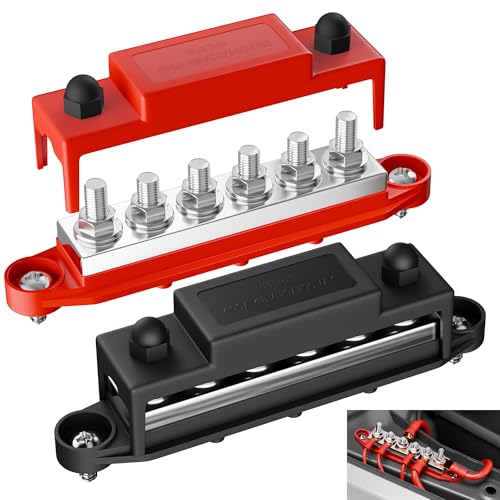
- 400A Heavy Duty: The 12V-48V...
- 5/16"(M8) Stud: The 400A...
- Upgrade & Thicken: A pair of...
The Joinfworld Bus Bar 400A is my pick for 48V marine setups because it hits that voltage ceiling without going overboard on size. Six 5/16″ (M8) studs give you a clean middle ground — more landing points than a four-stud bar, less bulk than the eight-stud T Tocas. The copper terminal block is built for solid conductivity.
This suits boats, RVs, and solar arrays that run 12V to 48V. It’s the sweet spot for a balanced install, though if you need to push past 400A, the 500A Joinfworld up top is the better call.
✅ Pros
- 48V DC rating suits marine and solar
- Six M8 studs balance capacity and size
- Copper terminal block for conductivity
- Positive and negative in one purchase
❌ Cons
- 400A cap rules out very high-draw builds
- M8 only — no M10 for thicker lugs
Positive and negative pair
RVBOATPAT 400A Bus Bar 12V Power Distribution Block 6 x 5/16″ (M8) Terminal Studs 12 Volt Marine Bus Bar Positive & Negative for Boat Automotive Solar System
400A Rating | 6x 5/16″ (M8) Studs | 12V | Positive & Negative | Boat & Solar

- 400A Heavy Duty: This 12 volt...
- High Quality: The tinned...
- Unique Design: The special...
The RVBOATPAT 400A Bus Bar is a solid all-rounder that covers boat, automotive, and solar jobs in one package. You get six 5/16″ (M8) terminal studs rated to 400A, and it ships as a positive and negative pair so you can wire both sides of the circuit right out of the box. For a straightforward 12V distribution point, it just works.
I’d point this at DIYers building a camper or small boat system who want a matched pair without overthinking it. Note it’s listed at 12V — if you’re running a 48V bank, go with the Joinfworld 400A above instead, which is rated to 48V.
✅ Pros
- Six M8 studs for multiple connections
- Positive and negative pair included
- 400A handles most 12V automotive loads
- Works across boat, car, and solar builds
❌ Cons
- Listed at 12V — not for 48V systems
- No cover mentioned in the specs
AC and DC rated
DaierTek 300A Bus Bar 12V Marine 12V Power Distribution Block with Cover 6 x 3/8″ (M10) Terminal Studs Max 300V AC 48V DC Positive & Ground Busbar for Automotive Car Boat
300A Rating | 6x 3/8″ (M10) Studs | 300V AC / 48V DC | With Cover | Positive & Ground

- 【Product Name】- Bus bar...
- 【300A M10 Stud Busbar...
- 【Round Corner Base】 - This...
The DaierTek 300A Bus Bar stands out because it’s rated for both 300V AC and 48V DC, which is unusual in this group. Six 3/8″ (M10) studs give you big, easy-to-grip terminals, and it comes with a cover to keep dust and stray contact out. For automotive DC work it’s a tidy, well-thought-out block.
This is my pick if you’re running a mixed panel — say an inverter or AC accessory alongside your 12V loads. The limitation is current: at 300A it’s the lowest rating on my list, so high-draw winch or dual-battery builds should look at the 400A and 500A options instead.
✅ Pros
- Rated for both 300V AC and 48V DC
- Six large 3/8″ (M10) studs
- Cover keeps terminals protected
- Positive and ground configuration
❌ Cons
- 300A is the lowest rating here
- Not enough headroom for very high-draw builds
Red and black pair
Seamaka 350A 12V-48V Bus Bar Marine Power Distribution Block with Cover with 6 x 3/8” Post, Battery Bus Bar (Pair, Red & Black), Automotive Busbars 12 Volt for Car Boat Solar Wiring
350A Rating | 6x 3/8″ Posts | 12V-48V | With Cover | Red & Black Pair
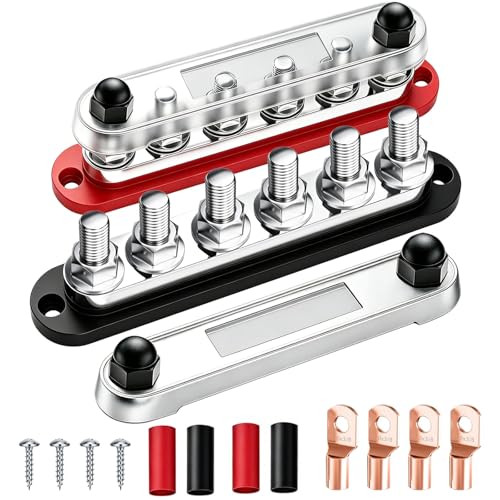
- Material: Bus conductor is...
- Product features: 180-wire...
- Parameters: Maximum voltage...
The Seamaka 350A Bus Bar is a nice middle-of-the-road pick that covers 12V to 48V in one block. You get six 3/8″ posts, a cover to shield the terminals, and it ships as a color-coded red and black pair so you can wire positive and negative sides without buying twice. At 350A it handles a wide range of automotive and solar jobs.
I’d steer this toward someone wiring a car, boat, or small solar setup who wants a matched pair and a bit of voltage flexibility. The honest catch is that 350A sits below the 400A and 500A options, so if you’re feeding a big winch or dual-battery bank, size up.
✅ Pros
- Rated across 12V to 48V
- Six 3/8″ posts for multiple cables
- Color-coded red and black pair included
- Cover keeps terminals protected
❌ Cons
- 350A is below the top-rated options
- 3/8″ posts only — no smaller M8 for light leads
Compact 4-stud layout
Joinfworld 400A Bus Bar 12V Power Distribution Block with 4 x 3/8″ Studs 12 Volt Marine Copper Battery Busbar Terminal Block for Car, Boat, Automotive, RV, Solar Wiring – Negative&Positive
400A Rating | 4x 3/8″ Studs | 12V | Copper Terminal | Positive & Negative

- 400A Heavy Duty: The 12V Bus...
- Superior Material: The 400A...
- 3/8" Stud Terminal: The...
The Joinfworld 400A Bus Bar with 4 x 3/8″ studs is the compact option on my list. Four big 3/8″ studs and a 400A rating give you real capacity without the bulk of a six- or eight-stud block, and the copper terminal block is built for solid conductivity. It ships as a positive and negative pair for a complete install.
This is the pick for tight spaces — a cramped engine bay, a small RV compartment, or a simple two-to-four cable junction. The trade-off is obvious: with only four studs, it’s not the one to choose if you need to land a lot of separate accessory leads.
✅ Pros
- 400A rating in a compact four-stud body
- Large 3/8″ studs fit common lugs
- Copper terminal block for conductivity
- Positive and negative pair included
❌ Cons
- Only four studs — limited connection points
- Listed at 12V, not for 48V systems
What to Look for in bus bars for automotive
Picking the right bus bar comes down to matching its current rating and stud layout to what you’re actually wiring. The biggest mistakes I see are buying a bar rated way below the load, or grabbing one with the wrong stud size so none of your lugs fit. Get those two things right and the rest is easy.
Current Rating (Amps)
The amp rating is the single most important number on the box. It tells you the maximum current the bar can carry without overheating. In this list the range runs from 300A up to 500A, and you want headroom above your expected load, not right at the edge. As a rule of thumb, pick a bar rated well above the total amps of everything you’ll connect, especially if you run a winch, inverter, or dual-battery bank.
Stud Size and Count
Studs are where your cable lugs bolt down, so the size has to match your lugs. You’ll see 5/16″ (M8) and 3/8″ (M10) studs here, and the bigger M10 studs suit thicker main cables while M8 works for most accessory leads. Count matters too: a four-stud bar is fine for a simple junction, but eight studs give you room for lots of separate circuits. Count your cables first, then pick the stud layout.
Voltage Range
Most automotive systems run 12V, but if you’re building a 48V marine or solar setup you need a bar rated for it. Several options here are rated to 48V DC, while others are listed at 12V only. Check this before you buy, because a 12V-rated bar isn’t the right choice for a higher-voltage bank. It’s an easy spec to overlook and an expensive one to get wrong.
Cover and Protection
A cover protects the terminals from moisture, dust, and accidental contact, which matters a lot in an engine bay or on a boat. Some bars here ship with a cover and some don’t. If your install is exposed to the elements, a covered bar is worth prioritizing. It’s a small feature that saves you a lot of grief down the road.
Positive and Negative Pairing
You need a landing point for both the positive and negative sides of your circuit. Some bars ship as a matched red and black pair, which saves you buying twice and keeps your wiring consistent. Others are sold as a single block. If you want a clean, color-coded install, look for a paired set.
Material and Build
Copper terminal blocks conduct better and hold up over time, so I lean toward those for anything that carries serious current. The build quality of the studs and base also affects how well everything stays tight under vibration. For a vehicle that sees rough roads, that durability is not something to skimp on.
My Shortcut Advice: Match the amp rating to your total load with headroom to spare, then confirm the stud size fits your lugs. Nail those two and you’ve avoided the most common mistakes.
Frequently Asked Questions
What is the best bus bar for automotive use?
For most people, the Joinfworld Heavy Duty 500A is the best bus bar for automotive work. It’s rated for 500A at 48V DC and gives you four 5/16″ (M8) studs plus two 3/8″ (M10) studs, so you can run thick main cables and smaller accessory leads on the same block. The waterproof cover is a genuine bonus in an engine bay. If you don’t need that much current, the 400A options are cheaper and plenty capable.
How many amps do I need for my automotive bus bar?
Add up the total current of everything you’ll connect, then pick a bar rated above that number. If you’re running a winch, inverter, or dual-battery bank, go with 400A or 500A so you have headroom. For a simple junction feeding lights and a couple of accessories, a 300A bar like the DaierTek is fine. Never run a bar right at its limit.
What’s the difference between M8 and M10 studs on a bus bar?
The number refers to the stud diameter, and it decides which cable lugs fit. M8 is 5/16″ and M10 is 3/8″, so M10 studs suit thicker main cables with bigger lugs. M8 works for most accessory leads. A bar that mixes both, like the 500A Joinfworld, gives you the most flexibility across different cable sizes.
Is a bus bar worth it for a car or truck?
Yes, absolutely, if you’re running more than one or two accessories. A bus bar gives every circuit a clean, bolted connection instead of a messy stack of wires on a battery terminal. It also makes troubleshooting much easier because you can isolate each circuit. For anything beyond a basic setup, it’s one of the best small upgrades you can make.
Can a bus bar handle a winch or high-draw accessory?
It can, but only if the amp rating is high enough. A winch can pull serious current, so you want a 400A or 500A bar with large studs. The T Tocas 400A with its eight 3/8″ studs is a strong choice for heavy draws. Don’t try this on a 300A bar, which is better suited to lighter loads.
Do I need a bus bar rated for 48V if my car is 12V?
No, a 12V-rated bar is fine for a standard 12V automotive system. You only need the 48V rating if you’re building a 48V marine or solar setup. Several bars on this list are rated to 48V DC, which gives you flexibility if you might upgrade later. Buying the higher rating never hurts, but it’s not required for a basic car install.
Should I get a bus bar with a cover?
I’d say yes if your install is exposed to moisture, dust, or accidental contact. A cover protects the terminals and helps prevent shorts, which matters in an engine bay or on a boat. The Joinfworld 500A, DaierTek 300A, and Seamaka 350A all come with covers. If your bar lives in a dry, protected spot, a cover is less critical.
What’s the difference between a positive bus bar and a ground bus bar?
A positive bar distributes power from your battery or source to multiple circuits, while a ground bar collects the return path back to the battery. Some bars are sold as a matched red and black pair so you can wire both sides cleanly. The DaierTek 300A is set up as a positive and ground busbar. For a complete install, having both is the way to go.
My Final Verdict
The Joinfworld Heavy Duty 500A is my overall winner, and it’s not close. It’s the only bar here rated for 500A, and it mixes four M8 studs with two larger M10 studs so you can land thick main cables and smaller accessory leads on the same block. The waterproof cover seals the deal for exposed engine bays. The T Tocas 400A is the best for high stud count, with eight 3/8″ studs for heavy multi-cable runs. The Joinfworld 400A is the best for 48V marine setups, with six M8 studs and a 48V DC rating.
If you need maximum current and flexibility, go with the 500A Joinfworld. If you’re landing a lot of separate cables, the eight-stud T Tocas is the smarter fit. And if you’re running a 48V marine or solar bank, the six-stud Joinfworld 400A hits the sweet spot. Any of the top three will serve you well.
Best overall: Joinfworld Heavy Duty 500A
- 500A Heavy Duty: The 12V Bus...
- Upgrade & Thicken: A pair of...
- 3/8" & 5/16" Studs: The Power...
Buy this if you want the most current capacity on the list with mixed stud sizes and a waterproof cover. Its 500A rating and 48V DC support give you room to grow.
Best for high stud count: T Tocas 400A
- This heavy-duty battery bus...
- High-load power distribution...
- This insulated buss bar 12v...
Buy this if you have a pile of cables to land in one spot. Eight 3/8″ studs and a 400A rating make it the go-to for multi-accessory distribution.
Best for 48V marine setups: Joinfworld Bus Bar 400A
- 400A Heavy Duty: The 12V-48V...
- 5/16"(M8) Stud: The 400A...
- Upgrade & Thicken: A pair of...
Buy this if you’re wiring a 48V marine or solar bank. Six M8 studs and a 48V DC rating hit the sweet spot between capacity and size.