
Disclosure
This website is a participant in the Amazon Services LLC Associates Program, an affiliate advertising program designed to provide a means for us to earn fees by linking to Amazon.com and affiliated sites.
The Joinfworld Bus Bar 400A 12V Power Distribution Block is the best bus bar for inverters for most people, with six 5/16″ (M8) studs and 48V marine-rated copper terminals that handle heavy inverter loads on negative and positive sides. I compared 7 products and ranked them best to worst.
- Best overall: Joinfworld Bus Bar 400A — six M8 studs, 48V marine rating, both polarities
- Best for RV and marine installs: RVMARINEPAT 400A Bus Bar — red and black pair with 6 included lugs
- Best for solar and auto wiring: RVBOATPAT 400A Bus Bar — positive and negative in one block, six M8 studs
My picks come down to three checkable things: terminal stud size and count, the DC voltage rating, and whether the block covers both positive and negative connections. I worked from the listed specifications, not hands-on testing, so you can verify every number yourself before buying.
Quick Comparison: best bus bars for inverters
| # | Product | Best For | Key Spec | Price |
|---|---|---|---|---|
| 1 | Joinfworld Bus Bar 400A 12V Best overall |
All-around inverter setups | 400A | Check Price → |
| 2 | RVMARINEPAT 400A Bus Bar Best for RV and marine installs |
RV and marine wiring | 6 lugs | Check Price → |
| 3 | RVBOATPAT 400A Bus Bar Best for solar and auto wiring |
Solar and auto wiring | 400A | Check Price → |
| 4 | Joinfworld Heavy Duty 500A Bus Bar Highest amperage, waterproof |
High-current waterproof builds | 500A | Check Price → |
| 5 | Joinfworld 400A Power Distribution Block Compact four-stud block |
Simple car and solar runs | 4 studs | Check Price → |
| 6 | LiTime 275A Bus Bar Nickel-plated copper |
Smaller RV and car systems | 275A | Check Price → |
| 7 | LiTime 275A Power Distribution Block Dual-polarity copper block |
Light-duty solar setups | 275A | Check Price → |
How I Selected These Products
I started with the numbers that actually matter for an inverter hookup: amperage rating, stud size and count, and DC voltage ceiling. A bus bar needs enough 5/16″ (M8) studs to land your inverter cable plus the battery and charge sources.
Then I weighed real-world usability. Dual-polarity blocks save space and wiring hassle, included lugs cut extra shopping, and a cover helps in tight engine bays. Value came down to what you actually get in the box, not just the headline rating.
Finally, I leaned on buyer feedback to catch the stuff specs hide, like loose hardware or awkward mounting. Products with steady, consistent reports of solid connections and clean installs ranked higher than ones with mixed results.
Best overall
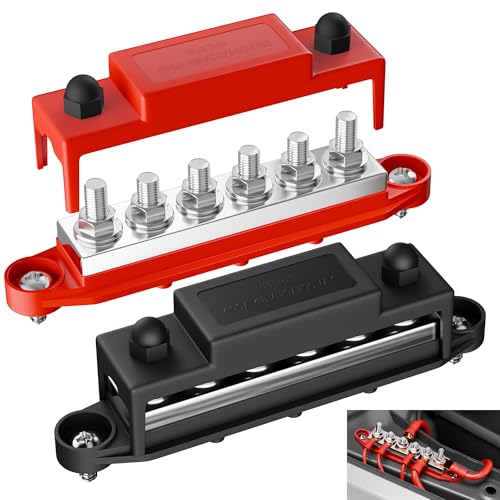
Joinfworld Bus Bar 400A 12V Power Distribution Block 6 x 5/16″(M8) Studs 48V Marine Bus Bar 12 Volt Battery Busbar Copper Terminal Block for Automotive
400A | 6 x 5/16″ (M8) Studs | 48V | Negative & Positive | Copper Terminal Block
- 400A Heavy Duty: The 12V-48V...
- 5/16"(M8) Stud: The 400A...
- Upgrade & Thicken: A pair of...
The Joinfworld Bus Bar 400A 12V Power Distribution Block earns my top spot because it gives you six 5/16″ (M8) studs on a 400A, 48V-rated copper block that covers both negative and positive. That stud count matters for inverters — you can land the inverter cable, the battery feed, and charge sources without doubling up lugs. It’s rated for 12V through 48V marine use, so it holds up in boats and solar builds too.
This is the one I’d point most people to for a straightforward inverter install. The catch: it’s a bare block with no cover, so if your mounting spot is exposed to spray or debris, you’ll want something enclosed instead.
✅ Pros
- Six 5/16″ (M8) studs handle multiple inverter connections
- 400A rating with 48V marine-grade copper terminals
- Covers both negative and positive in one block
- Works across 12V, 24V and 48V systems
❌ Cons
- No cover, so exposed mounting spots need extra protection
- Lugs not included, so budget for those separately
Best for RV and marine installs
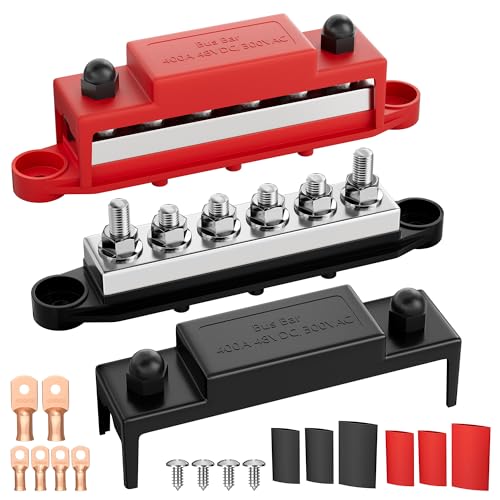
RVMARINEPAT 400A 12V 24V 48V Bus Bar with 6 x 5/16″ (M8) Studs
400A | 6 x 5/16″ (M8) Studs | 12V–48V DC | Red & Black Pair | 6 Lugs Included
- 400A HEAVY-DUTY CAPACITY FOR...
- PREMIUM THICK NICKEL-PLATED...
- COMPLETE INSTALLATION KIT WITH...
The RVMARINEPAT 400A 12V 24V 48V Bus Bar is the one I’d grab for an RV or boat build because it ships as a red and black pair with six lugs already in the box. You get 400A of continuous capacity across 12V, 24V and 48V DC, with six 5/16″ (M8) studs per block. Having both polarities and the lugs together saves a second order and keeps your wiring color-coded properly.
It’s ideal if you’re wiring an inverter in a moving vehicle where clean, labeled connections matter. The limitation is that it’s a newer listing with a smaller track record than the older Joinfworld blocks, so read the current reviews closely before committing.
✅ Pros
- Red and black pair covers both polarities
- Six lugs included, so no extra hardware run
- 400A continuous at 12V–48V DC
- Six 5/16″ (M8) studs per block
❌ Cons
- Newer listing with a shorter review history
- Included lug sizes may not match every cable gauge
Best for solar and auto wiring
RVBOATPAT 400A Bus Bar 12V Power Distribution Block 6 x 5/16″ (M8) Terminal Studs 12 Volt Marine Bus Bar Positive & Negative for Boat Automotive Solar System
400A | 6 x 5/16″ (M8) Studs | 12V | Positive & Negative | Marine Grade

- 400A Heavy Duty: This 12 volt...
- High Quality: The tinned...
- Unique Design: The special...
The RVBOATPAT 400A Bus Bar 12V Power Distribution Block is a solid pick for solar and auto wiring because it gives you 400A and six 5/16″ (M8) terminal studs in a positive-and-negative block. That’s plenty of landing points for an inverter plus panels and a battery feed in a compact solar setup. It’s built for 12V systems and rated for marine use, so it handles the vibration in a car or boat fine.
I’d choose this if you’re running a 12V solar array or a vehicle inverter and want both polarities in one tidy unit. The downside is the 12V focus — if you’re on a 24V or 48V system, go with a block rated for those voltages instead.
✅ Pros
- 400A rating with six 5/16″ (M8) studs
- Positive and negative in a single block
- Marine-grade build for cars, boats and solar
❌ Cons
- 12V-focused, not built for 24V or 48V systems
- Lugs sold separately
Highest amperage, waterproof
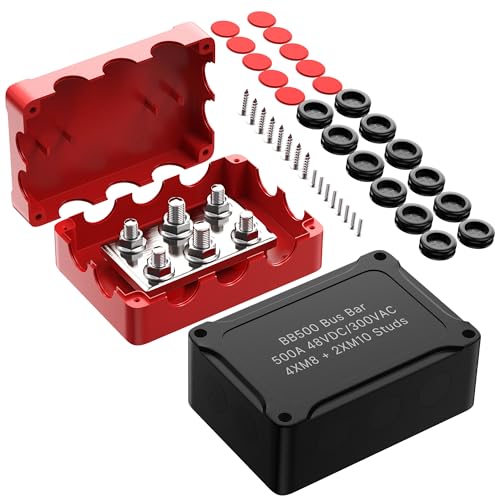
Joinfworld Heavy Duty 500A Bus Bar Waterproof Power Distribution Block with 45/16″(M8)+23/8″(M10) Studs 48V DC Automotive Marine Battery Terminal Distribution Block with Cover – Negative&Positive
500A | 4 x M8 + 2 x M10 Studs | 48V DC | Waterproof Cover | Negative & Positive
- 500A Heavy Duty: The 12V Bus...
- Upgrade & Thicken: A pair of...
- 3/8" & 5/16" Studs: The Power...
The Joinfworld Heavy Duty 500A Bus Bar Waterproof Power Distribution Block is the highest-rated block here at 500A, and it mixes stud sizes — four 5/16″ (M8) plus two 3/8″ (M10) — which is handy when your inverter cable needs a bigger lug. It’s rated to 48V DC and comes with a cover, so it’s the one I’d trust in a damp engine bay or exposed marine location. Both polarities are covered too.
This is for higher-current inverter setups where you want the extra headroom and a lid over the terminals. The trade-off is that it costs more than the 400A blocks and the mixed stud sizes mean you need to keep two lug types on hand.
✅ Pros
- 500A rating, the highest in this lineup
- Includes a cover for waterproof protection
- Two 3/8″ (M10) studs for heavier cable lugs
- 48V DC rated, negative and positive
❌ Cons
- Pricier than the 400A options
- Mixed M8 and M10 studs mean two lug types
Compact four-stud block
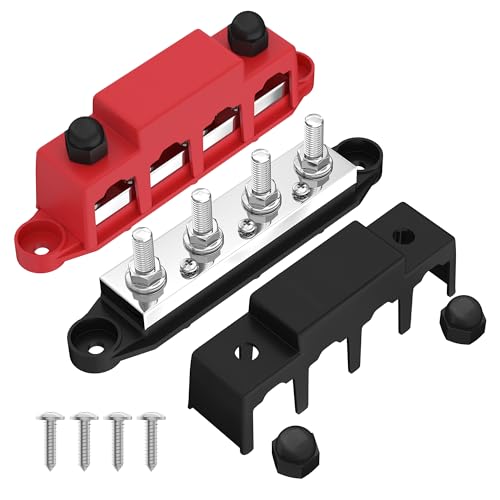
Joinfworld 400A Power Distribution Block 12V Bus Bar with 4 x 5/16″(M8) Studs Battery Bus Bar 48V DC Marine Terminal Block for Automotive Car Solar – Negative&Positive
400A | 4 x 5/16″ (M8) Studs | 48V DC | Negative & Positive | Marine Terminal Block
- 400A Heavy Duty: The 12V Bus...
- Superior Material: The 400A...
- 5/16" Stud Terminal: The...
The Joinfworld 400A Power Distribution Block 12V Bus Bar is the compact choice here, with four 5/16″ (M8) studs instead of six. It’s still 400A and rated to 48V DC, and it covers negative and positive, so it handles a basic inverter hookup fine. If you don’t need a lot of landing points, the smaller footprint is easier to tuck into a tight bay.
I’d pick this for simple car or solar runs with an inverter and one battery feed. The limitation is the four studs — if you plan to add panels, chargers and multiple loads later, go with the six-stud block at #1 instead.
✅ Pros
- 400A rating in a smaller footprint
- 48V DC rated, negative and positive
- Four 5/16″ (M8) studs for simple setups
❌ Cons
- Only four studs, so fewer connections
- No cover included
Nickel-plated copper
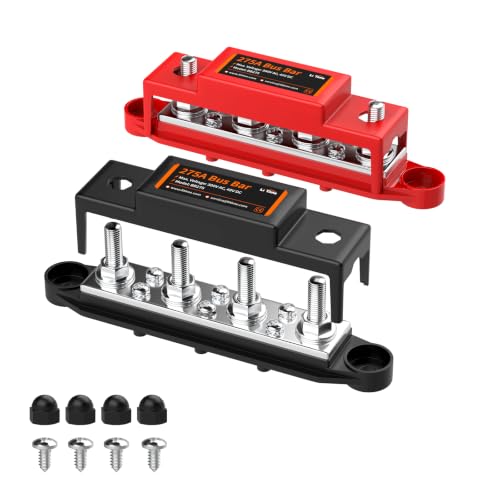
LiTime 275A Bus Bar
275A | 4 x 5/16″ (M8) Studs | 6 x #8 (M4) Screws | 48V DC / 300V AC | Nickel-Plated Copper
- 【M8 + M4 Dual Terminal...
- 【High Conductivity, Low...
- 【Reduced Fire Risk】Built...
The LiTime 275A Bus Bar stands out because it pairs four 5/16″ (M8) studs with six #8 (M4) screws, giving you a main circuit plus small auxiliary connections in one block. The nickel-plated copper body is rated to 48V DC and 300V AC, and it comes as a red and black pair. For an inverter setup, the M8 studs handle the heavy cable while the M4 screws take care of control or sensing wires.
This suits smaller RV, marine or car systems where you want both main and auxiliary terminals in one unit. The real limitation is the 275A rating — it’s well under the 400A blocks here, so a high-draw inverter should go with a higher-rated bar instead.
✅ Pros
- Dual M8 + M4 terminals for main and auxiliary circuits
- Nickel-plated copper resists corrosion
- Rated to 48V DC and 300V AC
- Red and black pair for both polarities
❌ Cons
- 275A rating is low for high-draw inverters
- Only four M8 studs for main connections
Dual-polarity copper block
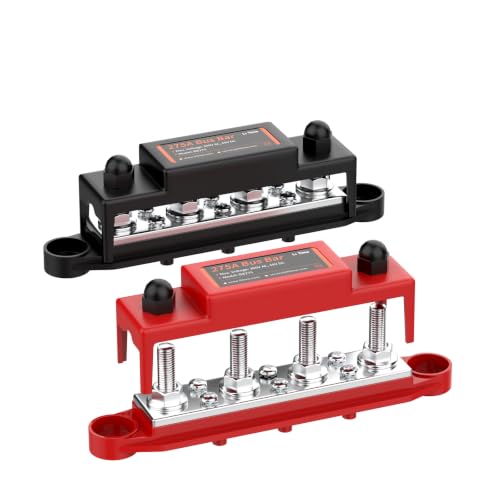
LiTime 275A Power Distribution Block
275A | 4 x 5/16″ (M8) Studs | 6 x #8 (M4) Screws | 48V DC / 300V AC | Negative & Positive
- 【M8 + M4 Dual Terminal...
- 【High Conductivity, Low...
- 【Reduced Fire Risk】Built...
The LiTime 275A Power Distribution Block uses the same M8 plus M4 layout as the #6 pick, with four 5/16″ (M8) studs for main power and six #8 (M4) screws for smaller circuits, all in nickel-plated copper. It’s rated to 48V DC and 300V AC and covers both negative and positive. I like the dual-terminal design for an inverter install that also needs a few low-current taps.
It fits light-duty solar, RV and car setups where 275A is enough. The catch is that it’s the lowest-rated block on this list, so if you’re pushing a big inverter, step up to a 400A or 500A bar.
✅ Pros
- M8 main studs plus six M4 auxiliary screws
- Nickel-plated copper construction
- Negative and positive in one unit
- Rated to 48V DC and 300V AC
❌ Cons
- 275A is the lowest rating in this lineup
- Only four M8 studs for main power runs
What to Look for in bus bars for inverters
Picking the wrong bus bar for an inverter is one of those mistakes that shows up later as a hot terminal or a melted lug. Most buyers focus on the amperage number and ignore stud size, voltage rating, and whether the block covers both polarities — then end up ordering the wrong lugs or a bar that’s undersized for their inverter’s draw.
Amperage Rating
Match the bus bar’s amp rating to your inverter’s continuous draw, not its peak surge. A 275A block works for smaller inverters, while 400A and 500A bars give you headroom for bigger loads and future additions. My rule of thumb: pick a rating at least 20% above what your inverter pulls continuously. The higher-rated blocks in this list exist for a reason — high-draw inverters will cook an undersized bar.
Stud Size and Count
Stud size determines which lugs fit, and count determines how many connections you can land. The 5/16″ (M8) stud is the common standard here, but a couple of blocks add 3/8″ (M10) studs for heavier cable. Count matters just as much: four studs handle a simple inverter-plus-battery setup, while six let you add charge sources and extra loads without doubling up. If you’re planning to expand, buy the extra studs now.
DC Voltage Rating
Check that the bar is rated for your system voltage, whether that’s 12V, 24V or 48V. Several blocks here are rated to 48V DC, which covers the common inverter setups, and a couple carry an AC rating too. A bar rated only for 12V shouldn’t go on a 48V system even if the amperage looks fine. Voltage rating is a hard limit, not a suggestion.
Positive and Negative in One Block
Dual-polarity blocks handle both the positive and negative runs in a single unit, which keeps your wiring tidy and saves mounting space. Single-polarity bars mean buying two and finding room for both. For an inverter install, a combined block is usually the cleaner choice. Just confirm the listing actually says negative and positive before you order.
Cover and Environmental Protection
If the bar lives in an engine bay, boat hull or anywhere damp, a cover is worth having. Exposed terminals collect moisture and debris, and a lid keeps things protected. Not every block here includes one, so factor that in if your mounting spot isn’t sheltered. In a dry, enclosed cabinet, a bare block is perfectly fine.
Build Material and Corrosion Resistance
Copper and nickel-plated copper are what you want for conductivity and corrosion resistance. Marine and automotive environments punish cheap metals, so a plated copper terminal block holds up far better over time. Look for the material in the listing — if it’s vague about the metal, that’s a warning sign.
My Shortcut Advice: Buy a bar rated at least 400A with six 5/16″ (M8) studs and both polarities — that covers almost every inverter setup and leaves room to grow, so you won’t be re-ordering in six months.
Frequently Asked Questions
What is the best bus bar for an inverter?
For most people, the Joinfworld Bus Bar 400A 12V Power Distribution Block is the best answer. It gives you six 5/16″ (M8) studs, a 400A rating, and 48V marine-grade copper terminals covering both negative and positive. That stud count lets you land the inverter cable, battery feed and charge sources without doubling up lugs. If you need more headroom, the 500A Joinfworld block is the step up.
How many amps do I need for my inverter bus bar?
Size the bar above your inverter’s continuous draw, not its surge. A 275A block is fine for smaller inverters, but I’d pick 400A or 500A for anything with real draw. My rule of thumb is at least 20% headroom over the continuous rating. The 400A Joinfworld and 500A Joinfworld blocks both give you that cushion.
What size studs should a bus bar for an inverter have?
The 5/16″ (M8) stud is the standard, and every block on this list uses it. Some add 3/8″ (M10) studs for heavier cable — the Joinfworld 500A block has four M8 plus two M10. Match your lug size to the stud, and don’t force a mismatched lug. If your inverter cable uses a bigger lug, the M10 studs are worth having.
Can I use a 12V bus bar on a 24V or 48V system?
Only if the bar is rated for that voltage. The Joinfworld 400A block is rated to 48V DC, so it works across 12V, 24V and 48V setups. The RVBOATPAT 400A bar is focused on 12V, so I wouldn’t put it on a 48V system. Voltage rating is a hard limit, not a guideline.
Do I need a negative and positive bus bar, or just one?
You need both polarities, so a combined block saves space and wiring. Most blocks here cover negative and positive in one unit, including the Joinfworld 400A and the RVMARINEPAT pair. If you buy a single-polarity bar, you’ll need two of them. Check the listing confirms both before ordering.
Is a bus bar for an inverter worth it?
Yes — it’s the clean way to join an inverter, battery and charge sources without stacking lugs on one terminal. A proper bar keeps connections tight and lets you add loads later. Skipping it usually means messy wiring and looser joints. For any real inverter install, it’s worth the small spend.
What’s the difference between a 400A and 500A bus bar?
It comes down to headroom and stud layout. The 400A blocks handle most inverter setups with six M8 studs, while the 500A Joinfworld adds two larger M10 studs and a waterproof cover. The 500A is the pick for higher-current or damp installs. For a standard setup, the 400A is plenty.
Can a bus bar handle both my inverter and solar panels?
Yes, if it has enough studs. A six-stud block like the Joinfworld 400A lets you land the inverter, battery and solar feed without doubling up. Four-stud blocks are tighter and better for simple setups. If you’re adding panels later, buy the extra studs now.
My Final Verdict
The Joinfworld Bus Bar 400A 12V Power Distribution Block is my overall winner, and it’s not close. Six 5/16″ (M8) studs, a 400A rating, and 48V marine-grade copper terminals covering both polarities give you everything a typical inverter install needs with room to grow. The RVMARINEPAT 400A 12V 24V 48V Bus Bar is my pick for RV and marine installs, thanks to the red and black pair with six lugs in the box. The RVBOATPAT 400A Bus Bar is my choice for solar and auto wiring, with six M8 studs on a 12V positive-and-negative block.
If you want one bar that covers most inverter setups and leaves room for panels and chargers later, go with the Joinfworld 400A. If you’re wiring a boat or RV and want lugs included, take the RVMARINEPAT. And if you’re building a 12V solar or auto system, the RVBOATPAT is the clean fit.
Best overall: Joinfworld Bus Bar 400A 12V
- 400A Heavy Duty: The 12V-48V...
- 5/16"(M8) Stud: The 400A...
- Upgrade & Thicken: A pair of...
Buy this if you want one bus bar that handles a standard inverter install with room to add charge sources. Six M8 studs and a 48V marine-grade copper block make it the most flexible pick here.
Best for RV and marine installs: RVMARINEPAT 400A Bus Bar
- 400A HEAVY-DUTY CAPACITY FOR...
- PREMIUM THICK NICKEL-PLATED...
- COMPLETE INSTALLATION KIT WITH...
Buy this if you’re wiring a boat or RV and want the lugs in the box. The red and black pair with six included lugs saves a second order and keeps your wiring color-coded.
Best for solar and auto wiring: RVBOATPAT 400A Bus Bar
- 400A Heavy Duty: This 12 volt...
- High Quality: The tinned...
- Unique Design: The special...
Buy this if you’re running a 12V solar array or vehicle inverter and want both polarities in one tidy block. Six M8 studs and a 400A rating cover the job.