Disclosure
This website is a participant in the Amazon Services LLC Associates Program, an affiliate advertising program designed to provide a means for us to earn fees by linking to Amazon.com and affiliated sites.
The Shirbly 2/0 AWG Flexible Battery Cable with 3/8″ Terminals is the best flexible battery cable for heavy inverter and welding runs because it uses OFC pure copper in the largest gauge here. I compared 7 products and ranked them best to worst.
- Best overall: Shirbly 2/0 AWG — largest gauge, OFC pure copper, 3/8″ terminals
- Best for battery bank wiring: FASTSTORM 2 AWG — 2 gauge OFC copper with 3/8″ terminals
- Best for short jumper runs: Linkstyle 6PCS 2 AWG — six 6-inch cables with tinned copper lugs
I picked these on three things anyone can check in the specs: conductor material, wire gauge and length, and lug size and plating. I did not run these in my own truck or boat — the picks come straight from the listed specifications and how each set is built.
Quick Comparison: best flexible battery cables
| # | Product | Best For | Key Spec | Price |
|---|---|---|---|---|
| 1 | Shirbly 2/0 AWG Flexible Battery Cable w Best overall |
Heavy inverter and welding runs | 2/0 AWG | Check Price → |
| 2 | FASTSTORM 2 AWG Battery Cable Best for battery bank wiring |
Everyday inverter and solar setups | 2 AWG | Check Price → |
| 3 | Linkstyle 6PCS 2 AWG Battery Cables 6 In Best for short jumper runs |
Tight battery bank links | 6 inch | Check Price → |
| 4 | Linkstyle 4PCS 1/0 AWG Battery Cable Kit Tinned lug kit |
High current inverter hookups | 1/0 AWG | Check Price → |
| 5 | A ABIGAIL 2 AWG Battery Cable 2AWG Gauge Short one-foot pair |
Close-mount inverter wiring | 1 FT | Check Price → |
| 6 | HiFind 4 Gauge AWG Battery Cables 3 Ft B Lighter 4 gauge pair |
Smaller solar and RV loads | 4 AWG | Check Price → |
| 7 | A ABIGAIL 4 AWG Battery Cable 6FT 4 Gau Long six-foot run |
Longer cable routing jobs | 6 FT | Check Price → |
How I Selected These Products
I started with the specs that actually matter for flexible battery cables: conductor material, wire gauge, and lug size. Pure copper OFC and tinned copper lugs got priority. I also checked cable length, since a 6-inch jumper and a 6-foot run solve very different problems.
Value came down to what you get per set, not just the sticker. A pair with proper 3/8″ terminals and real copper beats a bigger bundle with thin lugs every time. I ranked sets higher when the length and gauge matched a common real-world job.
Finally, I weighed buyer feedback and reliability signals like best-seller badges and purchase volume. Sets with steady sales and consistent feedback moved up. Anything with unclear specs or mismatched gauge claims dropped down the list.
Best overall
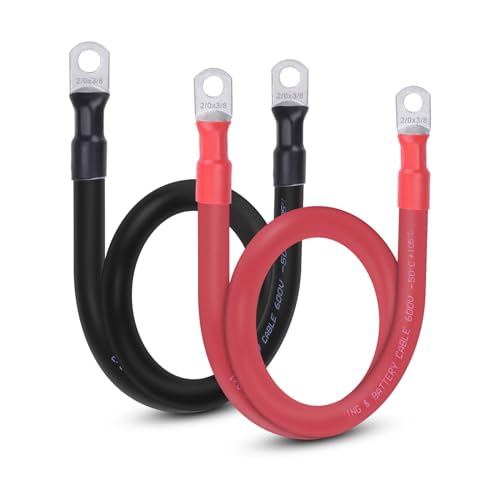
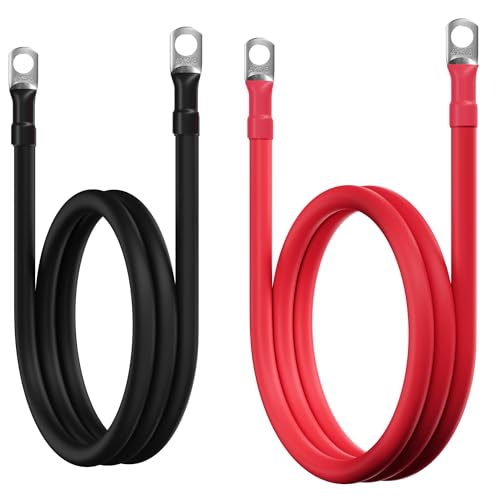
Shirbly 2/0 AWG Flexible Battery Cable with 3/8″ Terminals – OFC Pure Copper Inverter & Welding Wire for Automotive Solar RV Motorcycle (Red + Black 2FT Pair)
2/0 AWG | OFC Pure Copper | 3/8″ Terminals | 2FT Red + 2FT Black
- 【Pure Copper Wire...
- 【Easy to Use】: Each cable...
- 【Heavy Duty】: Rated for up...
The Shirbly 2/0 AWG Flexible Battery Cable earns the top spot because it brings the biggest conductor here — 2/0 gauge OFC pure copper — with 3/8″ terminals on both ends. That fat copper is what you want for inverter and welding runs where current is high and voltage drop hurts. It comes as a matched red and black pair at 2 feet each, so you can wire a full positive and negative run in one go.
This is best for anyone running a heavy inverter, welding lead, or solar bank where 2 AWG just feels thin. The honest catch: 2/0 is stiff, thick cable, so it’s overkill and harder to route in tight spaces. If you’re linking batteries in a cramped box, a smaller gauge set makes more sense.
✅ Pros
- Largest gauge in the lineup at 2/0 AWG for high-current runs
- OFC pure copper conductor for low resistance
- 3/8″ terminals on both ends, ready to bolt up
- Matched red and black 2FT pair in one set
❌ Cons
- 2/0 is thick and stiff, so tight routing is a pain
- Overkill for small loads and short battery links
- Only 2FT per cable, so long runs need another set
Best for battery bank wiring
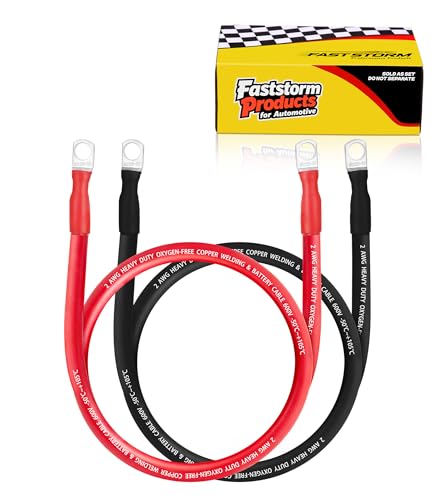
FASTSTORM 2 AWG Battery Cable, Flexible Inverter Cables 2 Feet with 3/8″ Terminals OFC Pure Copper 2 Gauge Welding Wire for Automotive Solar Marine Boat RV Car Motorcycle (Red + Black 2FT Pair)
2 AWG | OFC Pure Copper | 3/8″ Lugs Both Ends | 2FT Red + 2FT Black
- [Pure Copper Material] The...
- [Battery Cable Lugs] 3/8" tin...
- [PVC Insulation Protection...
The FASTSTORM 2 AWG Battery Cable is my pick for battery bank wiring because 2 AWG OFC pure copper is the sweet spot for most inverter and solar setups — thick enough for real current, flexible enough to actually route. You get 3/8″ lugs on both ends and a matched red and black pair at 2 feet each. It’s a sensible middle ground between the heavy 2/0 above and lighter 4 gauge sets.
Best for DIY solar and inverter builds where you’re linking batteries and want copper you can trust without wrestling a garden hose. The limitation: if you’re pushing serious amps through long runs, 2 AWG may not cut it — step up to the 2/0 instead. And 2 feet is short for anything beyond close-up mounting.
✅ Pros
- 2 AWG OFC pure copper for solid current handling
- 3/8″ lugs on both ends for a clean bolt-up
- Flexible enough to route around tight battery boxes
- Red and black 2FT pair covers a full run
❌ Cons
- 2 AWG is light for very high-current, long runs
- 2FT length limits where you can mount the inverter
- Newer listing with less track record than the top pick
Best for short jumper runs
Linkstyle 6PCS 2 AWG Battery Cables 6 Inch, Heavy Duty Pure Copper Battery Bank and Inverter Cable Set with Tinned Copper 3/8″ Lugs Terminals, for Solar, RV, Marine, Truck, Automotive 12V-48V
6 Pieces | 2 AWG | Pure Copper | Tinned Copper 3/8″ Lugs | 6 Inch | 12V-48V

- Complete 6PCS 2 AWG Cable Set...
- Premium Material: The 2 AWG...
- Tin-Plated Copper Terminals...
The Linkstyle 6PCS 2 AWG Battery Cables 6 Inch set is my go-to for short jumper runs because six 6-inch cables let you link a whole battery bank without cutting wire. Each one is 2 AWG pure copper with tinned copper 3/8″ lugs, and the tinned plating is a real plus for marine and damp environments. It’s rated for 12V-48V systems, so it covers everything from a small solar bank to a 48V setup.
Best for anyone wiring series or parallel battery connections where the runs are short and you want them tidy. The limitation is obvious: at 6 inches, these are jumpers only — you can’t use them for a run to an inverter across the compartment. For longer runs you’ll need a separate pair.
✅ Pros
- Six 6-inch cables cover a full battery bank link
- Tinned copper lugs resist corrosion in damp setups
- 2 AWG pure copper for solid current on short runs
- Works across 12V-48V systems
❌ Cons
- 6-inch length is jumpers only, not for long runs
- Six pieces may be more than a small setup needs
- Short cables leave little slack for routing
Tinned lug kit
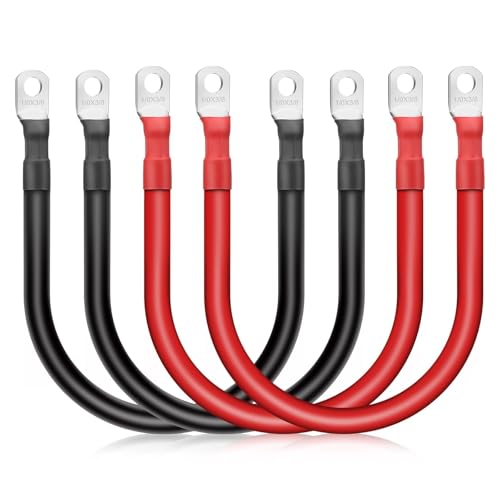
Linkstyle 4PCS 1/0 AWG Battery Cable Kit 12 Inch, Heavy Duty High Current Pure Copper Inverter Cables with 3/8″ Tinned Copper Lugs, for Inverter, Solar, Marine, RV
4 Pieces | 1/0 AWG | Pure Copper | 3/8″ Tinned Copper Lugs | 12 Inch
- Heavy Duty Battery Cable Kit...
- M10 Tin-Plated Copper...
- PVC Insulating: Designed with...
The Linkstyle 4PCS 1/0 AWG Battery Cable Kit 12 Inch is a step up in gauge from the 2 AWG sets, and that 1/0 pure copper handles high-current inverter work well. You get four 12-inch cables — two red and two black — with 3/8″ tinned copper lugs on both ends. The tinned lugs are the standout here, since they hold up better against corrosion in marine and RV setups.
Best for high-current inverter hookups where you want heavier copper than 2 AWG but don’t need the full 2/0. The catch: 12 inches is a specific length, so it’s great for close mounting but won’t reach across a larger compartment. If your layout needs more slack, measure first.
✅ Pros
- 1/0 AWG pure copper for high-current inverter work
- Tinned copper 3/8″ lugs resist corrosion
- Four 12-inch cables (2 red, 2 black) in one kit
- Good fit for marine and RV environments
❌ Cons
- 12-inch length won’t reach across larger compartments
- 1/0 is heavier and stiffer than 2 AWG to route
- Fewer pieces than the 6-cable jumper set
Short one-foot pair
A ABIGAIL 2 AWG Battery Cable 2AWG Gauge Pure Copper Battery Inverter Cables with 3/8 in Lugs Both Ends Power Inverter Wire Set for Automotive Solar Marine Boat RV Car Motorcycle Red and Black (1FT)
2 AWG | Pure Copper | 3/8″ Lugs Both Ends | 1FT Red + Black

- 【High Quality】A ABIGAIL...
- 【Safe & Durable】Premium...
- 【Wide Application】Our...
The A ABIGAIL 2 AWG Battery Cable is a compact 1-foot pair in 2 AWG pure copper with 3/8″ lugs on both ends. It’s a solid choice when your inverter or battery sits close and you don’t want a pile of extra cable to coil up. The red and black pair keeps the positive and negative runs matched, and 2 AWG is plenty for moderate inverter loads.
Best for tight installs where the battery and inverter are inches apart, like a small car audio or compact solar setup. The limitation is the 1-foot length — there’s almost no slack, so if you misjudge the mounting distance you’re stuck. Measure twice before ordering this one.
✅ Pros
- 2 AWG pure copper for moderate inverter loads
- 3/8″ lugs on both ends for a quick bolt-up
- 1FT length keeps compact installs tidy
- Matched red and black pair
❌ Cons
- 1-foot length leaves almost no slack
- Too short for most standard mounting distances
- 2 AWG limits very high-current applications
Lighter 4 gauge pair
HiFind 4 Gauge AWG Battery Cables 3 Ft Black+3 Ft Red, Pure Copper Power Inverter Wire Set with 3/8 in Lugs Both Ends, High Power Flexible for Automotive Solar Marine Boat RV Car Motorcycle-Outdoor-UL
4 AWG | Pure Copper | 3/8″ Lugs Both Ends | 3FT Black + 3FT Red | UL
- Premium Conductor: Oxygen-free...
- High-Strength Flexible Jacket...
- Easy Installation: Available...
The HiFind 4 Gauge AWG Battery Cables give you a 3-foot black and 3-foot red pair in oxygen-free pure copper, with a high-strand count conductor that keeps the wire flexible. The 3/8″ lugs on both ends make it a bolt-on job, and it carries a UL listing, which is a nice bit of confidence. At 3 feet per cable, it fits more layouts than the short 1-foot and 2-foot sets.
This is best for smaller solar and RV loads where 4 gauge is enough and you want extra length to route cleanly. The honest limitation: 4 AWG is lighter copper, so it’s not the pick for high-current inverter runs — step up to a 2 AWG or 1/0 set for that.
✅ Pros
- Oxygen-free pure copper with high-strand count for flexibility
- 3FT per cable gives more routing room than short sets
- 3/8″ lugs on both ends, ready to bolt up
- UL listed for added confidence
❌ Cons
- 4 AWG is light for high-current inverter runs
- Only one red and one black, so no spare jumpers
- 3FT may be too long for very tight installs
Long six-foot run
A ABIGAIL 4 AWG Battery Cable 6FT 4 Gauge Pure Copper Battery Inverter Cables with 3/8 in Lugs Both Ends Power Inverter Wire Set for Automotive Solar Power Inverter Marine Boat RV Car Motorcycle (6FT)
4 AWG | Pure Copper | 3/8″ Lugs Both Ends | 6FT

- 【High Quality】A ABIGAIL...
- 【Safe & Durable】Premium...
- 【Wide Application】Our...
The A ABIGAIL 4 AWG Battery Cable 6FT is the long-run option in this list, giving you a full 6 feet of 4 gauge pure copper with 3/8″ lugs on both ends. That extra length is what makes it useful when your battery and inverter are far apart and short cables just won’t reach. The pure copper and tinned construction keeps it a solid, corrosion-resistant choice for marine and RV work.
This is best for longer cable routing jobs where distance matters more than raw current capacity. The limitation: 4 AWG over 6 feet means more resistance, so for high-current inverter runs you’re better off with a heavier gauge like 2 AWG or 1/0.
✅ Pros
- Full 6FT length for longer routing jobs
- Pure copper with tinned construction for corrosion resistance
- 3/8″ lugs on both ends for a clean bolt-up
- Suited to marine, boat and RV environments
❌ Cons
- 4 AWG over 6FT adds resistance on high-current runs
- 6FT is excess length for close-mount setups
- Lighter gauge than the 2 AWG and 1/0 options here
What to Look for in flexible battery cables
Buying the wrong battery cable is a quiet way to lose power or, worse, start a fire — undersized copper heats up under load. I see people make two mistakes over and over: picking gauge by looks instead of current, and forgetting to check lug size before they order.
Wire Gauge (AWG)
Gauge is the single most important number on the label, and smaller AWG means thicker copper. A 2/0 AWG cable carries far more current than a 4 AWG one, so match the gauge to your load and run length. For high-current inverter or welding work, go heavier; for short battery links and small loads, 4 AWG is often plenty. My rule of thumb: when in doubt, size up — thicker copper runs cooler and drops less voltage.
Conductor Material
Look for pure copper or, better, oxygen-free copper (OFC). Copper conducts far better than aluminum-clad wire, and the “pure copper” claim is worth checking in the specs. Tinned copper lugs add corrosion resistance, which matters a lot in marine and damp RV setups. If a listing is vague about the conductor, that’s a red flag.
Lug Size and Termination
The lugs have to match your battery terminals and bus bars, and 3/8″ is the most common size in this category. Check that lugs are on both ends unless you plan to crimp your own. Look for tinned copper lugs over bare ones if you’re wiring anything exposed to moisture. A cable with the wrong lug size is useless no matter how good the copper is.
Cable Length
Length affects both fit and resistance — longer runs drop more voltage, especially at lighter gauges. Short 6-inch jumpers are ideal for linking batteries in a bank, while 2- to 6-foot cables suit inverter and route-to-mount jobs. Measure your actual mounting distance before ordering; a 1-foot cable with no slack is a common regret. Buy for the run you have, not the run you might want later.
Flexibility and Strand Count
Flexible cable gets its bend from a high strand count, so more fine strands means easier routing around tight corners. This matters most in vehicles, boats, and RVs where you’re threading wire through awkward spaces. Very heavy gauges like 2/0 are inherently stiffer, so plan your route before you commit. If flexibility is your priority, a high-strand 2 AWG or 4 AWG set will treat you better than a fat 2/0.
System Voltage and Rating
Check that the cable is rated for your system — many sets cover 12V up to 48V, which handles most solar, RV, and marine builds. A UL listing is a nice extra bit of confidence on the insulation and construction. Match the rating to your setup so you’re not guessing at the margins.
My Shortcut Advice: Measure your mounting distance and confirm your lug size first, then pick the thickest gauge that fits your budget and space — thicker copper is the safest upgrade you can make.
Frequently Asked Questions
What is the best flexible battery cable for heavy inverter and welding runs?
For heavy current, I’d go with the Shirbly 2/0 AWG set. It uses the largest conductor here — 2/0 AWG OFC pure copper — with 3/8″ terminals on both ends, which is exactly what high-current inverter and welding work needs. It comes as a matched 2-foot red and black pair so you can wire a full run in one go. Just know that 2/0 is thick and stiff, so it’s not the easiest cable to route in tight spaces.
What’s the difference between 2 AWG and 2/0 AWG battery cable?
2/0 AWG is much thicker copper than 2 AWG, and it carries noticeably more current with less voltage drop. If you’re running a big inverter or welding lead, the 2/0 wins; for everyday battery bank wiring, a 2 AWG set like the FASTSTORM is plenty. The trade-off is flexibility — the heavier 2/0 is harder to bend. Pick based on your load and how tight your routing is.
What is the best battery cable set for battery bank wiring?
I like the FASTSTORM 2 AWG set for battery bank wiring. It’s 2 AWG OFC pure copper with 3/8″ lugs on both ends and a matched red and black 2-foot pair — a sensible middle ground between heavy 2/0 and lighter 4 gauge. If your bank links are very short, the Linkstyle 6PCS 2 AWG 6-inch set is actually the better fit because six short jumpers let you link the whole bank without cutting wire.
Is pure copper battery cable worth it over aluminum-clad wire?
Yes, without question. Pure copper and oxygen-free copper conduct far better than aluminum-clad wire, which means less voltage drop and less heat under load. Every set on this list uses pure copper or OFC, and several add tinned copper lugs for corrosion resistance. If a listing is vague about the conductor material, I’d skip it — copper is the whole point.
What size lugs do I need for battery cables?
3/8″ is the most common lug size and every cable in this list uses it. The key is to match the lug to your actual battery terminals and bus bars before you order. Check that lugs are on both ends unless you plan to crimp your own, and favor tinned copper lugs if the setup is exposed to moisture. A cable with the wrong lug size is useless no matter how good the copper is.
How long should my battery cables be?
Measure your actual mounting distance first — this is where most buyers get burned. Short 6-inch jumpers like the Linkstyle set are ideal for linking batteries in a bank, while 2-foot pairs suit close inverter mounting and 6-foot cables like the A ABIGAIL 4 AWG handle longer routing jobs. Remember that longer runs drop more voltage, especially at lighter gauges, so don’t buy extra length you don’t need.
Can a 4 AWG battery cable handle a power inverter?
It depends on the inverter and the run length. A 4 AWG set like the HiFind or the A ABIGAIL 6FT works fine for smaller solar and RV loads, but 4 AWG over a long 6-foot run adds resistance that hurts high-current work. For a serious inverter, I’d step up to 2 AWG or 1/0 AWG. Size up when in doubt — thicker copper runs cooler.
Are tinned copper lugs better than bare copper?
For marine, boat, and damp RV setups, yes. Tinned copper lugs like those on the Linkstyle 1/0 AWG kit resist corrosion far better than bare copper, which matters when the wiring is exposed to moisture. In a dry, protected install the difference is smaller, but tinning never hurts. If your cable lives anywhere near water, I’d always favor tinned.
My Final Verdict
My overall pick is the Shirbly 2/0 AWG Flexible Battery Cable. It wins because it brings the biggest conductor here at 2/0 AWG OFC pure copper, pairs it with 3/8″ terminals on both ends, and ships as a matched red and black 2-foot pair so you can wire a full run in one order. That fat copper is exactly what high-current inverter and welding work demands. For battery bank wiring, the FASTSTORM 2 AWG is the sensible all-rounder. For short jumper runs, the Linkstyle 6PCS 2 AWG 6-inch set is the tidy six-cable choice.
Still undecided? If you’re pushing serious current through an inverter or welding lead, go with the 2/0 Shirbly. If you’re linking batteries in a bank and want flexible copper that routes easily, the FASTSTORM 2 AWG is the better fit. And if your runs are all short jumpers, grab the Linkstyle six-pack and skip the cutting.
Best overall: Shirbly 2/0 AWG Flexible Battery Cable
- 【Pure Copper Wire...
- 【Easy to Use】: Each cable...
- 【Heavy Duty】: Rated for up...
Buy this if you’re running a heavy inverter, welding lead, or solar bank where 2 AWG feels thin. The 2/0 AWG OFC pure copper with 3/8″ terminals is the strongest conductor on the list.
Best for battery bank wiring: FASTSTORM 2 AWG Battery Cable
- [Pure Copper Material] The...
- [Battery Cable Lugs] 3/8" tin...
- [PVC Insulation Protection...
Buy this if you’re wiring a battery bank and want 2 AWG OFC copper that’s thick enough for real current but flexible enough to route. The 3/8″ lugs and 2-foot red and black pair make it a clean bolt-on job.
Best for short jumper runs: Linkstyle 6PCS 2 AWG Battery Cables 6 Inch
- Complete 6PCS 2 AWG Cable Set...
- Premium Material: The 2 AWG...
- Tin-Plated Copper Terminals...
Buy this if you’re linking a battery bank in series or parallel and want tidy short runs. Six 6-inch 2 AWG cables with tinned copper 3/8″ lugs let you wire the whole bank without cutting wire.