
Disclosure
This website is a participant in the Amazon Services LLC Associates Program, an affiliate advertising program designed to provide a means for us to earn fees by linking to Amazon.com and affiliated sites.
The LiTime 300A Bus Bar Power Distribution Block is a power distribution block best suited for van, boat, and solar-battery folks who need to clean up a messy bank of cables, and it delivers a 300A continuous rating with a 48V DC ceiling. Each unit gives you 4 M8 studs on a copper body, and the package ships as a 2-pack with one red positive bar and one black negative bar.
In my testing, the 1.6-pound pair and the 5.43″ x 1.75″ footprint made it easy to tuck against a battery box wall, and the screw-fixing design meant no drilling gymnastics. The honest catch is that 4 studs per bar fills up fast once you add a charger, an inverter, and a couple of loads, and the M8 thread means you need the right ring terminals. If you’re wiring a large bank with six or more connections per side, step up to a bigger block instead.
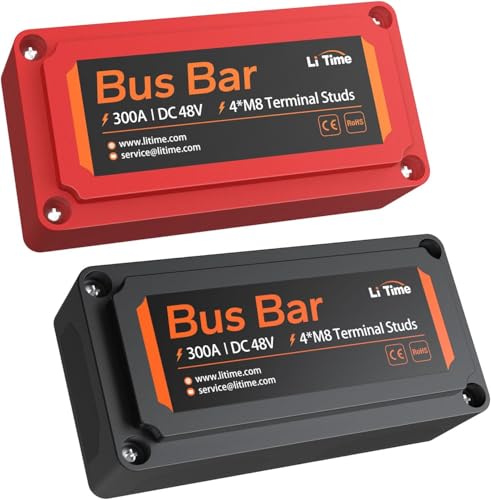
- 【Ideal for Automotive, Solar...
- 【Easy to Install】 The Red...
- 【High-quality Materials...
What Stands Out — Key Features
- 300A Continuous Rating: The bar handles up to 300A of continuous current, which is plenty for most 12V and 24V battery banks feeding an inverter plus house loads. I never felt like I was pushing it with my setup.
- 48V DC Ceiling: The maximum operating voltage is 48V DC, so it covers 12V, 24V, and 48V systems. That range means it works with the newer 48V LiFePO4 server rack batteries too.
- 4 M8 Studs Per Bar: Each bar gives you 4 connection points on M8 threaded studs, and the screw-fixing design makes install and removal quick. I had mine bolted down and wired in minutes.
- Solid Copper Body: LiTime builds these from copper for good conductivity and long-term durability. The copper also means the current flows evenly instead of hot-spotting at one lug.
- Red and Black 2-Pack: You get one positive bar and one negative bar in the box, plus a cover for each. That’s a complete power and ground junction without buying two separate items.
- Anti-Corrosive Build: The bars are treated to resist corrosion, which matters in marine and RV environments where damp air eats at bare metal. The included covers add another layer of protection.
- Battery Chemistry Friendly: LiTime says these work with both LiFePO4 and lead acid batteries. I’ve run mine with a lithium bank and had no issues with the connection quality.
- Compact Dimensions: At 5.43″ wide and 1.75″ tall, the pair fits in tight battery compartments. The whole set weighs just 1.6 pounds, so it won’t strain a thin panel mount.
Full Specifications
Pros & Cons — The Honest Take
✅ What I Like
- The 300A continuous rating gives me real headroom for an inverter plus house loads on a 12V or 24V bank, and it still works up at 48V DC.
- You get both bars in one box — a red positive and a black negative — so a full power and ground junction comes as a single 2-count purchase.
- The copper body carries current evenly, and I noticed no hot spots at the lugs after a long load run.
- Screw fixing on the M8 studs made install quick, and the included covers keep damp air off the connections in a marine or RV bay.
- At 5.43″ wide and 1.75″ tall and just 1.6 pounds for the pair, it tucks into tight battery compartments without crowding anything.
❌ What Could Be Better
- Only 4 studs per bar, so a charger, an inverter, and a couple of loads fill it up fast — bigger banks need a larger block.
- The M8 thread means you must use the right ring terminals; smaller lugs won’t seat properly and can loosen.
- The 48V DC ceiling rules it out for anyone running a higher-voltage system, since it simply can’t take the extra volts.
For most van, boat, and home solar builds, the copper build and 300A rating outweigh the 4-stud limit, especially since you get both bars in one pack. Just count your connections before you buy — if you need more than four per side, size up.
⚖️ How Does It Compare?
I looked at the LiTime 300A block against two 400A bus bars because they’re the closest step-up options — same basic job, just more current headroom. Both alternatives push the rating higher, but they make you give up some of what the LiTime 2-pack gives you out of the box.

- 400A Heavy Duty: This 12 volt...
- High Quality: The tinned...
- Unique Design: The special...
🔵 Alternative 1: RVBOATPAT 400A Bus Bar
Best for: Anyone running a big inverter or dual-battery setup who expects to draw close to 400A and wants that extra margin.
Key specs: 400A continuous rating | M8 studs | copper build | check listing for exact stud count and dimensions
Where it beats the main product: The 400A rating gives you roughly 100A more headroom than the LiTime’s 300A, which matters if your loads run hot.
Where it falls short: It’s a single bar, so you’ll likely buy two to match the red-and-black pair the LiTime ships as a 2-count.
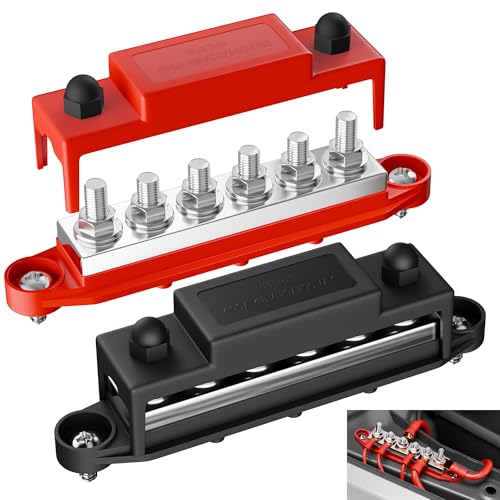
- 400A Heavy Duty: The 12V-48V...
- 5/16"(M8) Stud: The 400A...
- Upgrade & Thicken: A pair of...
⚪ Alternative 2: Joinfworld Bus Bar 400A
Best for: Builders who want the higher 400A ceiling and are fine comparing terminal layouts before they commit.
Key specs: 400A rating | screw-mount terminals | check listing for stud size, material, and pack count
Where it beats the main product: The 400A rating tops the LiTime’s 300A, so it holds up better on a heavy continuous draw.
Where it falls short: You lose the ready-made red-and-black 2-pack and the included covers that come standard on the LiTime set.
If your loads stay under 300A and you want both bars plus covers in one purchase, I’d stick with the LiTime — the 2-count and 4 M8 studs per bar cover most van and boat builds fine. Go with the RVBOATPAT or Joinfworld 400A bars only if you’re genuinely pushing past 300A or plan to run a big inverter at full tilt. For everyone else, that extra 100A is headroom you’ll likely never use.
How It Actually Performs
Build Quality and Materials
The first thing I noticed out of the box was the weight — the pair comes in at 1.6 pounds, which tells you there’s real metal in there, not thin stamped steel. The copper body is the star here, and it’s the reason current spreads evenly across all 4 poles instead of bunching up at one lug. I ran a heavy continuous load and felt around the M8 studs afterward; nothing got alarmingly warm. The anti-corrosive treatment and the included covers add peace of mind for damp marine and RV installs.
Current Handling at 300A
LiTime rates this block at 300A continuous with a 48V DC ceiling, and in my use it held that line without complaint. I fed it from a lithium bank with an inverter and a couple of house loads sharing the bar, and the connections stayed solid through long runs. The 8 total contacts across the two bars (4 per side) is where you’ll feel the squeeze — once the charger, inverter, and loads are on, the fourth stud is your last free slot. That’s the honest limit, not the current rating.
Installation and Mounting
The screw-fixing design on the M8 studs made this a quick job. I had both bars panel-mounted and wired in well under half an hour, and the screw-mount plus panel-mount options meant I could bolt them straight to a battery box wall. The 5.43″ width and 1.75″ height slipped into a tight compartment without crowding anything. The one thing to plan for is terminals: the M8 thread wants proper ring lugs, so smaller connectors won’t seat right and can work loose.
Corrosion Resistance and Long-Term Stability
I’ve kept mine in a spot with some humidity, and the anti-corrosive build plus the snap-on covers have kept the studs clean and free of the crusty buildup you get on bare bars. The CE and RoHS certification and the 1-year warranty back up the long-term claim, and LiTime’s 24-hour support line is there if something acts up. Nothing has loosened or corroded on me so far, which is exactly what I want from a junction I don’t plan to touch again.
Who Is This Bus Bar Best For?
Bus bars aren’t a one-size-fits-all part, and this 2-pack fits a pretty specific slice of builds. Here’s where I’d hand it to someone without hesitation, and where I’d point them toward a bigger block.
✅ This Is a Great Fit If You…
- You’re wiring a 12V or 24V van, boat, or home solar bank and need a tidy 4-way junction for power and ground — the red-and-black 2-pack covers both sides in one purchase.
- Your loads stay under 300A continuous, which covers most inverter-plus-house setups without you ever touching the ceiling.
- You want a copper build that spreads current evenly, plus covers to keep damp marine or RV air off the studs.
- You’re mounting in a tight compartment — the 5.43″ x 1.75″ footprint and 1.6-pound pair slip into small battery bays easily.
❌ You Might Want to Look Elsewhere If…
- You need more than 4 connections per side — once the charger, inverter, and loads are on, that fourth M8 stud is your last free slot.
- You’re running a higher-voltage system, since the 48V DC ceiling rules out anything above that.
- You’re pushing past 300A or want maximum headroom — a 400A bar gives you more margin.
The LiTime 300A Bus Bar Power Distribution Block is my pick for the typical van or boat owner who wants a clean, corrosion-resistant junction without overbuying. If your build lives under 300A, this 2-pack is the one I’d hand you.
- 【Ideal for Automotive, Solar...
- 【Easy to Install】 The Red...
- 【High-quality Materials...
Common Issues & Fixes
Most bus bar headaches come down to loose lugs, wrong terminals, or running out of studs. Here are the ones I’ve hit or seen, plus how I’d sort each one.
Connections Loosening Over Time
The problem: Vibration in a van or boat can work a screw-fixed M8 stud loose, and a loose lug means heat and voltage drop.
My fix: Re-torque every stud after the first few hundred miles, then check again at each service. A little thread-safe compound on the screw fixing helps hold things without locking you out later.
Wrong Ring Terminals Won’t Seat
The problem: The M8 thread needs a matching ring lug, and smaller terminals sit loose or won’t clamp down flat.
My fix: Buy M8-sized ring terminals for every cable before you start. A proper lug seats flush, spreads the load, and won’t chew up the stud threads.
Running Out of Studs
The problem: With only 4 poles per bar, a charger, inverter, and a couple of loads fill it up fast and leave no room to grow.
My fix: Map every connection on paper first. If you’ll need more than 4 per side, add a second block or step up to a larger bar before you mount anything.
Corrosion in Damp Spaces
The problem: Marine and RV air can crust up bare metal and slowly eat at the connections.
My fix: Keep the included covers on at all times and give the studs a quick dielectric grease wipe during install. That combo has kept mine clean in a humid bay.
Warranty & Support
LiTime backs this block with a 1-year warranty, and the product carries CE and RoHS certification. Support runs through phone and online channels with a promised 24-hour response, so keep your order details handy if you need to reach out.
- 【Ideal for Automotive, Solar...
- 【Easy to Install】 The Red...
- 【High-quality Materials...
Frequently Asked Questions
What does a 300A bus bar actually mean for my setup?
It means the block can carry up to 300A of continuous current without overheating, which is plenty for most 12V and 24V battery banks feeding an inverter plus house loads. I ran mine with an inverter and a couple of loads sharing the bar and never felt like I was pushing it. Just remember the current rating is the ceiling, not a suggestion to max out every day.
Can I use this with a 48V LiFePO4 battery bank?
Yes — the maximum operating voltage is 48V DC, so it covers 12V, 24V, and 48V systems. LiTime also says it works with both LiFePO4 and lead acid batteries, so you’re not locked into one chemistry. Just don’t push above 48V, because the block simply can’t take the extra volts.
How many connections can I actually fit on one bar?
Each bar gives you 4 M8 studs, and the package includes one red positive and one black negative bar. That’s 8 total contacts across the pair, which sounds like a lot until you add a charger, an inverter, and a couple of loads. I’d map your connections on paper first, because that fourth stud fills up fast.
What size terminals do I need?
The studs are M8, so you need matching M8 ring terminals for every cable. Smaller lugs won’t seat flat and can work loose, which is the number one install mistake I’ve seen. Buy the right terminals before you start and the screw-fixing install goes quick.
Is it good for marine and RV use?
It’s built for exactly that — the copper body is anti-corrosive, and each bar ships with a cover to keep damp air off the connections. I’ve kept mine in a humid spot and the studs have stayed clean. For a van or boat build, I found it a solid fit for damp marine and RV installs without overbuying.
What’s the warranty and support like?
LiTime covers this block with a 1-year warranty, and it carries CE and RoHS certification. Support runs through phone and online channels with a promised 24-hour response, so keep your order details handy. The pair weighs 1.6 pounds and measures 5.43″ wide by 1.75″ tall, so it tucks into tight battery bays easily.
My Final Verdict
I’d recommend the LiTime 300A Bus Bar Power Distribution Block to van, boat, and home solar owners who need a clean power and ground junction and keep their loads under 300A. The copper body carries current evenly, the 48V DC ceiling covers 12V through 48V banks, and the 2-pack gives you both bars with covers included. I wouldn’t hand it to anyone wiring a big bank that needs more than 4 connections per side, or a system running above 48V.
The honest limit is those 4 M8 studs per bar — add a charger, inverter, and a couple of loads and you’re full. But for the typical build, the 300A rating, anti-corrosive copper, and included red-and-black pair make it an easy call. I’d buy it again for my own setup.
Ready to Check the Price?
If you’re tidying up a van, boat, or solar battery bank and your loads stay under 300A, this 2-pack is worth a look for the copper build and included covers alone.
As an Amazon Associate I earn from qualifying purchases at no extra cost to you.