
Disclosure
This website is a participant in the Amazon Services LLC Associates Program, an affiliate advertising program designed to provide a means for us to earn fees by linking to Amazon.com and affiliated sites.
The Joinfworld Bus Bar 400A 12V Power Distribution Block is the best bus bar for dual batteries because its six 5/16″ (M8) copper terminal studs handle both negative and positive connections in one 48V-rated unit. I compared 7 products and ranked them best to worst.
- Best overall: Joinfworld Bus Bar 400A — six M8 copper studs, negative and positive
- Best for boat and marine wiring: RVBOATPAT 400A Bus Bar — 400A marine rating with six M8 terminal studs
- Best for compact automotive installs: Joinfworld 400A Power Distribution Block — four M8 studs in a smaller footprint
I picked these based on three things you can check in the specs: the amp rating and voltage ceiling, how many M8 studs each block gives you, and whether it covers both positive and negative terminals. No hands-on testing here — just the listed specifications compared side by side.
Quick Comparison: best bus bars for dual batteries
| # | Product | Best For | Key Spec | Price |
|---|---|---|---|---|
| 1 | Joinfworld Bus Bar 400A 12V Power Distri Best overall |
Six-stud dual battery builds | 400A | Check Price → |
| 2 | RVBOATPAT 400A Bus Bar 12V Power Distrib Best for boat and marine wiring |
Marine and solar systems | 400A | Check Price → |
| 3 | Joinfworld 400A Power Distribution Block Best for compact automotive installs |
Tight automotive spaces | 4 studs | Check Price → |
| 4 | LiTime 275A Bus Bar Nickel-plated copper |
Small screw accessory runs | 275A | Check Price → |
| 5 | LiTime 275A Power Distribution Block Dual polarity block |
RV and car electrical | 275A | Check Price → |
| 6 | RVMARINEPAT 12V Bus Bar 250A Power Distr Six-stud mid-power |
Car and marine setups | 250A | Check Price → |
| 7 | Joinfworld Power Distribution Block Bus Four-stud 250A build |
Simple dual battery wiring | 250A | Check Price → |
How I Selected These Products
I started with the specs that actually matter for a dual battery setup: amp rating, voltage ceiling, and stud count. A block needs enough 5/16″ (M8) studs to run both batteries and your accessories without stacking terminals.
Then I looked at value and real-world fit. A 400A block with six studs makes sense for a big build, but a four-stud 250A unit is easier to fit in a tight engine bay. Matching capacity to the job mattered more than raw numbers.
Finally, I weighed reliability signals like consistent user feedback and whether each block covers both negative and positive connections. Products with clear polarity labeling and solid copper terminals ranked higher because they cut down on wiring mistakes.
Best overall
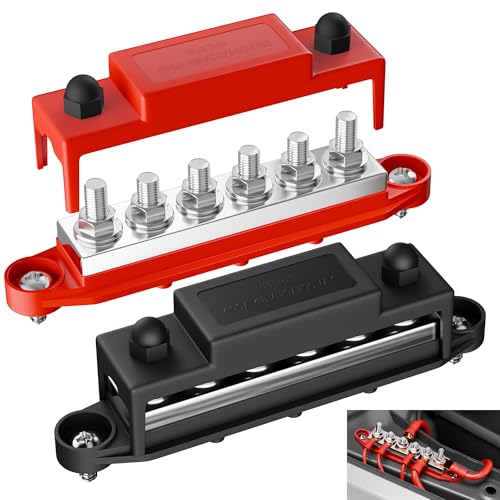
Joinfworld Bus Bar 400A 12V Power Distribution Block 6 x 5/16″(M8) Studs 48V Marine Bus Bar 12 Volt Battery Busbar Copper Terminal Block for Automotive
400A | 6 x 5/16″ (M8) Studs | 48V DC | Copper Terminals | Negative & Positive
- 400A Heavy Duty: The 12V-48V...
- 5/16"(M8) Stud: The 400A...
- Upgrade & Thicken: A pair of...
The Joinfworld Bus Bar 400A sits at the top of my list because it gives you the most room to work with. Six 5/16″ (M8) studs mean you can land both batteries plus a stack of accessories without doubling up terminals. The 400A rating and 48V DC ceiling cover almost any dual battery build I can think of, and the copper terminal block handles the current cleanly.
This is the one I’d point to for a serious dual battery setup in a boat, van, or solar install where you need plenty of connection points. The catch: six studs take up real space, so if you’re squeezing this into a tight engine bay you may want the four-stud version instead.
✅ Pros
- Six M8 studs give you lots of connection points
- 400A rating handles heavy dual battery loads
- 48V DC ceiling works for higher-voltage systems
- Covers both negative and positive in one unit
❌ Cons
- Six studs take up more mounting space
- Overkill if you only need a couple of connections
Best for boat and marine wiring
RVBOATPAT 400A Bus Bar 12V Power Distribution Block 6 x 5/16″ (M8) Terminal Studs 12 Volt Marine Bus Bar Positive & Negative for Boat Automotive Solar System
400A | 6 x 5/16″ (M8) Studs | 12V Marine | Positive & Negative | Boat / Solar

- 400A Heavy Duty: This 12 volt...
- High Quality: The tinned...
- Unique Design: The special...
The RVBOATPAT 400A Bus Bar is my pick for boat and marine wiring, and it’s a close second to the top spot. It matches the winner on the big numbers — 400A, six 5/16″ (M8) terminal studs, and dual positive and negative terminals. If your dual battery setup lives on the water, this block is built around that use case.
This is best for marine and solar installs where you want a high stud count and a clean marine-focused design. The honest limitation is that it’s essentially the same spec sheet as the #1 pick, so if you’re not specifically wiring a boat there’s little to separate them beyond availability.
✅ Pros
- 400A rating for heavy marine loads
- Six M8 studs for multiple connections
- Positive and negative in a single block
- Built with marine and solar systems in mind
❌ Cons
- Specs are nearly identical to the #1 pick
- Six studs need decent mounting room
Best for compact automotive installs
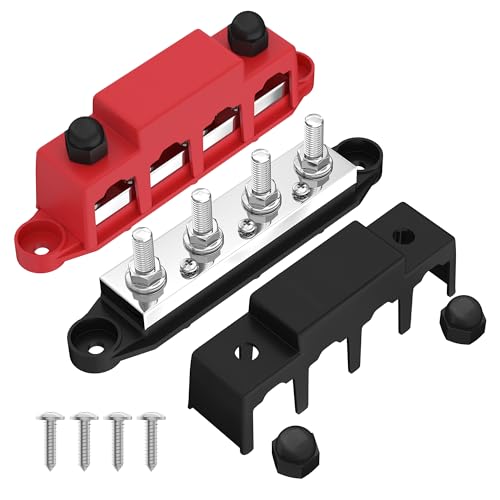
Joinfworld 400A Power Distribution Block 12V Bus Bar with 4 x 5/16″(M8) Studs Battery Bus Bar 48V DC Marine Terminal Block for Automotive Car Solar – Negative&Positive
400A | 4 x 5/16″ (M8) Studs | 48V DC | Negative & Positive | Automotive / Solar
- 400A Heavy Duty: The 12V Bus...
- Superior Material: The 400A...
- 5/16" Stud Terminal: The...
The Joinfworld 400A Power Distribution Block is my pick for compact automotive installs. It keeps the 400A rating and 48V DC ceiling of the bigger blocks but drops to four 5/16″ (M8) studs, so it fits where a six-stud unit won’t. For a dual battery setup in a car with limited room, that trade-off is worth it.
This is best for tight engine bays and simpler dual battery wiring where four studs cover your needs. The limitation is obvious: if you’re running a lot of accessories you’ll run out of studs fast, and then you’ll want the six-stud version up top.
✅ Pros
- Still 400A despite the smaller footprint
- Four M8 studs fit tighter spaces
- 48V DC rating for flexible systems
- Covers negative and positive connections
❌ Cons
- Only four studs, so fewer connections
- Not ideal if you’re running many accessories
Nickel-plated copper
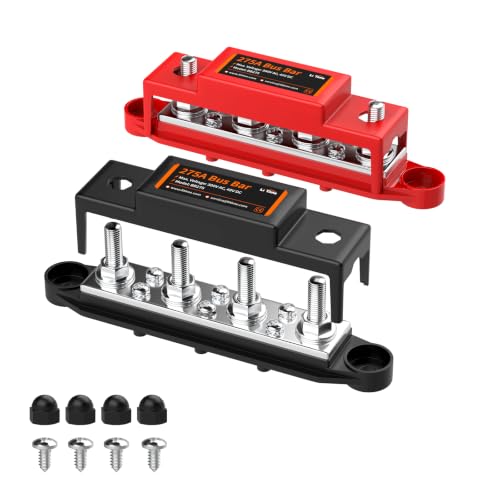
LiTime 275A Bus Bar
275A | 4 x 5/16″ (M8) Studs | 6 x #8 (M4) Screws | 48V DC / 300V AC | Nickel-Plated Copper
- 【M8 + M4 Dual Terminal...
- 【High Conductivity, Low...
- 【Reduced Fire Risk】Built...
The LiTime 275A Bus Bar takes a different approach with its dual terminal design. You get four 5/16″ (M8) studs for your main dual battery runs plus six #8 (M4) screws for smaller accessory circuits, all in one block. The nickel-plated copper build and 48V DC / 300V AC rating give it plenty of range.
This is best for RV and solar setups where you want main and auxiliary circuits on the same block. The limitation is the 275A rating — if your dual battery build pulls serious current, the 400A blocks above give you more headroom.
✅ Pros
- M8 studs plus six M4 screws for accessory runs
- Nickel-plated copper construction
- Handles 48V DC and 300V AC
- Red and black color coding
❌ Cons
- 275A is lower than the 400A options
- Only four M8 studs for main connections
Dual polarity block
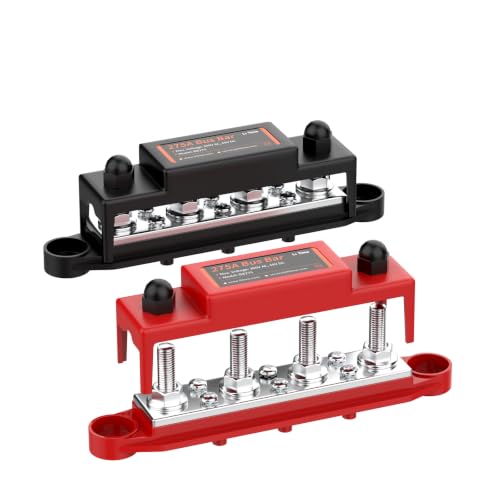
LiTime 275A Power Distribution Block
275A | 4 x 5/16″ (M8) Studs | 6 x #8 (M4) Screws | 48V DC / 300V AC | Nickel-Plated Copper
- 【M8 + M4 Dual Terminal...
- 【High Conductivity, Low...
- 【Reduced Fire Risk】Built...
The LiTime 275A Power Distribution Block is the negative-and-positive sibling of the #4 pick, and it runs the same dual terminal design. Four 5/16″ (M8) studs carry the 275A main current while six #8 (M4) screws take the smaller 15A circuits. The nickel-plated copper and 48V DC / 300V AC rating make it a solid all-rounder for a dual battery setup.
This is best for RV, marine, and car systems where you want both polarities and accessory screws in one tidy block. The limitation is the same as its twin: 275A won’t keep up with a high-draw build, so step up to a 400A option if that’s your plan.
✅ Pros
- Negative and positive in one block
- Four M8 studs plus six M4 screws
- Nickel-plated copper build
- Rated for 48V DC and 300V AC
❌ Cons
- 275A caps out below the 400A blocks
- Four main studs limit heavy multi-accessory wiring
Six-stud mid-power
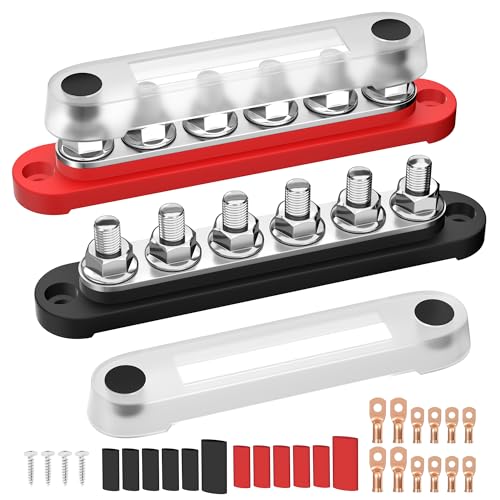
RVMARINEPAT 12V Bus Bar 250A Power Distribution Block
250A | 6 x 5/16″ (M8) Studs | 12V | Positive & Negative | Car / Marine / Solar
- Robust Terminals & Electrical...
- Unique Round Corner Base...
- More Open Area Cover Design...
The RVMARINEPAT 12V Bus Bar 250A is the block I’d reach for when I want plenty of studs without jumping to 400A. It gives you six 5/16″ (M8) terminal studs and both positive and negative connections. For a dual battery setup that doesn’t pull huge current, that’s a smart balance of connection points and capacity.
This is best for car, marine, and solar systems where you need a lot of terminals but a moderate 250A ceiling. The honest limitation is the 250A rating itself — if your dual battery build draws serious amps, the 400A blocks higher up give you more safety margin.
✅ Pros
- Six M8 studs for lots of connections
- Positive and negative in one block
- 250A suits moderate dual battery loads
- Works for car, marine, and solar
❌ Cons
- 250A is lower than the 400A options
- Six studs still need mounting room
Four-stud 250A build
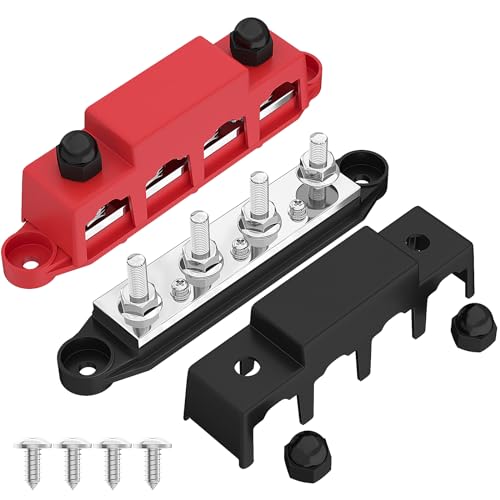
Joinfworld Power Distribution Block Bus Bar 12V 250A with 4 x 5/16″(M8) Studs Marine Bus Bar 12 Volt DC Battery Busbar Terminal Block for Automotive
250A | 4 x 5/16″ (M8) Studs | 12V DC | Negative & Positive | Automotive / Boat / Solar
- Upgrade and Thicken: A pair of...
- 250A Rating: The marine...
- 5/16" Stud Terminal: The...
The Joinfworld Power Distribution Block Bus Bar 12V 250A is the simplest option on my list, and that’s its appeal. Four 5/16″ (M8) studs cover both negative and positive connections in a 250A, 12V DC block. For a straightforward dual battery setup where you just need a clean junction point, it does the job without extra complexity.
This is best for basic automotive, boat, and solar wiring where four studs are enough. The limitation is that 250A and four studs won’t stretch far if you’re adding lots of accessories or running high-current gear — that’s when I’d move up to a 400A block.
✅ Pros
- Four M8 studs for straightforward wiring
- Covers negative and positive connections
- 250A, 12V DC rating for basic builds
- Compact design fits tight spots
❌ Cons
- Only four studs, so limited connections
- 250A caps out on high-current builds
What to Look for in bus bars for dual batteries
The right bus bar keeps your dual battery wiring safe, tidy, and able to handle the current you throw at it. Pick the wrong one and you’re looking at heat, loose connections, or a block that simply runs out of studs halfway through the install. The biggest mistake I see buyers make is grabbing the cheapest block without checking the amp rating against their actual load.
Amp Rating (Current Capacity)
The amp rating is the first number I check. A 250A block is fine for moderate dual battery setups, but if you’re running an inverter or heavy accessories, step up to 400A. Match the rating to your worst-case current draw, not your average. Going higher than you need is safe; going lower is not. When in doubt, size up.
Stud Count and Size
Stud count decides how many connections you can make without stacking terminals. Four 5/16″ (M8) studs suit simple dual battery wiring, while six give you room for batteries plus accessories. Stacking too many lugs on one stud creates a poor connection and heat. Count what you’ll actually connect, then add one spare.
Voltage Rating
Check the voltage ceiling before you buy. Most blocks here handle 12V easily, but the better ones go up to 48V DC, which gives you flexibility if you ever move to a higher-voltage system. Some units also list an AC rating. A higher ceiling costs little and future-proofs your setup.
Terminal Material
Copper and nickel-plated copper terminals conduct current well and resist corrosion. That matters in a boat or anywhere moisture creeps in. Cheaper blocks may use thinner plating that wears through over time. I lean toward copper-based terminals every time for a dual battery build that needs to last.
Polarity Setup (Positive and Negative)
Some blocks give you both positive and negative terminals in one unit; others are single-polarity. A combined block keeps your wiring tidy and saves space, but you need to be careful with labeling so you don’t cross wires. If you’re new to this, a clearly color-coded dual-polarity block is the safer pick.
Mounting and Footprint
Measure your mounting spot before ordering. A six-stud block takes up noticeably more room than a four-stud version, and tight engine bays punish you for guessing. Look at the overall dimensions, not just the stud count. If space is tight, the smaller block wins even if it has fewer connections.
My Shortcut Advice: Match the amp rating to your heaviest load and count your connections before buying — a 400A block with six studs covers almost any dual battery build, so size up rather than run short.
Frequently Asked Questions
What is the best bus bar for dual batteries?
The Joinfworld Bus Bar 400A is my top pick for dual batteries. It gives you six 5/16″ (M8) studs and handles both negative and positive connections in one 48V DC-rated block. That combination of stud count and 400A capacity covers almost any dual battery setup. If you’re wiring a boat specifically, the RVBOATPAT 400A offers the same 400A and six-stud layout with a marine focus.
Do I need a 400A bus bar or is 250A enough?
It depends on your heaviest load. A 250A block like the RVMARINEPAT or the Joinfworld 250A handles moderate dual battery setups fine. But if you’re running an inverter or heavy accessories, go 400A. Going higher than you need is always safe — going lower isn’t.
How many connections do I need on a bus bar for dual batteries?
Count every terminal you’ll actually land, then add one spare. Two batteries plus a few accessories usually means four studs is the minimum. If you’re wiring batteries plus a charger plus multiple loads, six studs is the safer choice. Stacking too many lugs on one stud hurts the connection.
What’s the difference between a 4-stud and 6-stud bus bar?
It comes down to connection count versus footprint. A four-stud block like the Joinfworld 400A with 4 x M8 studs fits tighter spaces and suits simpler wiring. A six-stud version gives you more terminals but takes up more mounting room. Pick based on how many connections you need and how much space you have.
Is a bus bar worth it for a dual battery setup?
Yes, absolutely. A bus bar gives you one clean junction point instead of a tangle of stacked lugs and loose wires. That means fewer poor connections and less heat. It also makes troubleshooting far easier when something goes wrong. For any dual battery build, it’s worth the small investment.
Can a bus bar handle 48V systems?
Some can. The Joinfworld 400A blocks and both LiTime 275A blocks are rated up to 48V DC, so they’ll handle higher-voltage setups. The LiTime units also list a 300V AC rating. Always check the voltage ceiling on the block before you buy — not every bus bar goes above 12V.
What material should a bus bar terminal be made of?
Copper or nickel-plated copper is what I look for. Both conduct current well and resist corrosion, which matters in boats and damp environments. The LiTime blocks use nickel-plated copper, and the Joinfworld units use copper terminals. Cheaper blocks with thin plating can wear through over time.
Can I use one bus bar for both positive and negative?
Yes, if the block is built for it. Most of the picks here — including the Joinfworld 400A and the LiTime 275A — give you both positive and negative terminals in one unit. That keeps wiring tidy and saves space. Just be careful with labeling so you never cross the wires.
My Final Verdict
The Joinfworld Bus Bar 400A is my overall best pick, and I’ll tell you why in three reasons. First, six 5/16″ (M8) studs give you room for both batteries plus accessories without stacking lugs. Second, the 400A rating and 48V DC ceiling handle just about any dual battery build. Third, it covers negative and positive in one copper-terminal block. The RVBOATPAT 400A is my choice for boat and marine wiring, matching the top spot on specs with a marine focus. The Joinfworld 400A with four studs is my pick for compact automotive installs where space is tight.
If you’re still undecided, here’s the framework. Need maximum connections and current headroom? Go with the six-stud 400A block up top. Working in a tight engine bay? The four-stud version fits where the big one won’t. On the water? The RVBOATPAT is built for marine duty.
Best overall: Joinfworld Bus Bar 400A
- 400A Heavy Duty: The 12V-48V...
- 5/16"(M8) Stud: The 400A...
- Upgrade & Thicken: A pair of...
Buy this if you want the most connection points and current headroom for a serious dual battery build. Six M8 studs and a 400A rating make it the safest all-round choice.
Best for boat and marine wiring: RVBOATPAT 400A Bus Bar
- 400A Heavy Duty: This 12 volt...
- High Quality: The tinned...
- Unique Design: The special...
Buy this if your dual battery setup lives on the water. It matches the top pick’s 400A rating and six M8 studs with a marine-focused design.
Best for compact automotive installs: Joinfworld 400A Power Distribution Block
- 400A Heavy Duty: The 12V Bus...
- Superior Material: The 400A...
- 5/16" Stud Terminal: The...
Buy this if you need 400A capacity in a tight engine bay. Four M8 studs keep the footprint small without dropping the current rating.